"Assembling an exhibition by hand, deciding what got a label and what stayed in a closet, taught me that a canon isn't found, it's assembled, and assembling always means leaving something out."
I had never really thought about a building before this summer. On the first day of the Athens Curatorial Project, we stood in front of ordinary structures I would have walked past a hundred times, and it turned out every one of them was carrying an argument: who built it, who paid for it, what it wanted the country to be. Within two weeks I couldn't stand on my own balcony without reading the polykatoikias across the street, the private deals that stacked the city upward one apartment at a time in the absence of any plan.
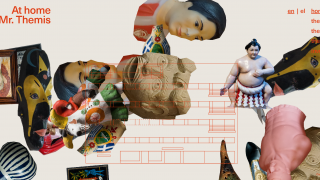
That question sat underneath everything I did in Athens. Our seminar built an exhibition out of the apartment of a collector, Mr. Themis, and I curated three objects from it: an untitled oil by Pericles Pantazis of a man fishing, a Kuniyoshi woodblock of the Battle of Yashima, and a four-eyed ceramic face-vessel nobody can attribute. What held them together was something I had been circling for weeks, that everything I was learning about Greece had been chosen by someone. Framed, labeled, or left in storage. And that this is not a Greek peculiarity. Japan curates itself the same way. Every country paints the war it wants to remember.
The work behind that was slower and less glamorous than it sounds. I went back to the National Gallery twice on my own after Christina taught us to hunt for the small historical jokes buried in a canvas, spent a free day in other galleries instead of at the beach, and let people who knew far more than I did correct me, which they did, often. I bought more books in Greek and English than my suitcase was built for, and translated pieces of the Greek myself.
What I did not expect was how much this would clarify Columbia. The Core treats a particular idea of the Greeks as the foundation of the West, and that idea is under challenge constantly on campus. Assembling an exhibition by hand, deciding what got a label and what stayed in a closet, taught me that a canon isn't found, it's assembled, and assembling always means leaving something out. That made me more generous toward academia rather than less. Selection is the job. The honest question is whether you admit the frame.
I went partly because I am a quarter Greek and wanted to get closer to that. I came back understanding there is no single Greece to fold neatly into myself, and that letting a place be a living place instead of a symbol I need something from is the more honest relationship to have with it. The Global Learning Scholarship is what made the month possible. I am still working through what it taught me, some of it into a novel I am writing about the trip.