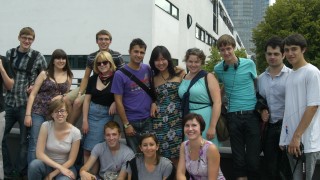
"One of the most meaningful parts of the experience was realizing how global research is shaped by who gets represented in it."
Growing up in Kenya, climate change was never an abstract concept to me. I had seen its effects in increasingly unpredictable weather patterns and, more recently, devastating flooding. Yet I became equally interested in a different question: why, despite experiencing these effects, do people respond so differently to conversations about climate change?
This question brought me to Cambridge through Columbia’s Global Behavioral Science (GLOBES) program. As part of the Junior Researcher Programme, I joined students and researchers from around the world to study how conversations with artificial intelligence can shape people’s attitudes toward social impact topics. Our project involved developing and refining a behavioral study, recruiting participants across over 20 countries, developing the manuscript, and learning how to use various data visualization tools like R and Tableau.
One of the most meaningful parts of the experience was realizing how global research is shaped by who gets represented in it. As a Kenyan student studying in the United States and conducting research in the United Kingdom, I became much more conscious of the responsibility researchers have to ensure that the conclusions we draw about human behavior actually reflect the diversity of the people those conclusions may eventually affect.

GLOBES also allowed me to connect several of my academic interests. At Columbia, I study neuroscience alongside public health, and I am interested in the intersection of human behavior, public policy, and communication. In Cambridge, those interests became tangible. I learned not only how behavioral research is designed, but also how emerging technologies such as large language models can become tools for studying how people form and reconsider their beliefs.
The Global Learning Scholarship made it possible for me to take advantage of this experience while managing the significant costs associated with studying abroad, including program tuition and housing in Cambridge. That support allowed me to focus more fully on the academic and research opportunities available to me.
By the end of the program, I left with a clearer understanding of the kind of work I hope to pursue: research that is globally representative, attentive to local contexts, and capable of informing responsible public policy.