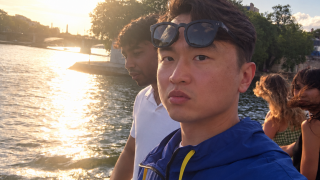
Register now for the virtual Columbia Summer in Paris Opportunities | Info Session on Friday, December 11th, 2026, from 11:00 AM to 12:00 PM via Zoom! Even if you cannot attend, please sign up, and we will send you a recording of the information session!
Immerse yourself in one of the world’s most vibrant cultural capitals on the Columbia Summer in Paris: English Track. The academic curriculum is suitable for many different majors, and students do not need to have a French language background to apply.
Program Overview
Through this program, students will engage with the rich and complex history, culture, and society of France and the broader Francophone world while completing coursework taught in English. The curriculum offers opportunities to deepen one’s understanding of Parisian life and explore the diverse dimensions of French and Francophone cultures. Students will take a total of six points.
This program will take place from Saturday, June 12th, 2027, to Friday, July 23rd, 2027. The program will start with an in-depth Orientation Week, which will include mandatory meetings and excursions to help you get to know the city of Paris and familiarize you with French culture. Some classes will start during Orientation Week; others will start the week following. Classes are typically held Monday through Thursday, while on Fridays, activities are planned in conjunction with the courses to provide more cultural exposure to the city.
We encourage you to watch the Columbia Summer in Paris Opportunities | Info Session with the Director of Columbia Undergraduate Programs, Séverine Martin, for an overview of the structure of the program and the application components:
Eligibility and Application
ELIGIBILITY
- Currently enrolled undergraduate students in good academic and disciplinary standing
- Graduate students and post-graduates are all eligible to apply
- Minimum 3.0 cumulative GPA. Students must also maintain a 3.0 GPA during the semester before going abroad
How to apply
Want to apply? Click the “Start Your Application" button at the top of this page. If the button doesn't appear, the program is not yet accepting applications. You will be asked to set up a short profile, which will allow us to send you relevant information about your application. Once you’ve created a profile, you will see a checklist of items that you will need to submit. These generally include:
- Application Items
- Official Transcript(s)
- Statement of Interest
- Home School Approval/Clearance: If applying from another university, please check with your home university's study abroad office about applying for permission to attend the program and transfer the credit.
- Application Fee (if applying from another university)
Academics
Participants choose their courses according to personal aspirations and interests as well as the course schedule. Course selection will take place after you confirm your place in the program. While efforts will be made to honor students' requests, enrollment in any particular course cannot be guaranteed.
Please note that the course offerings and schedule are still subject to change. Attendance at all class meetings, concerts, and excursions, unless otherwise indicated, is mandatory. Note that you cannot "mix-and-match" courses across programs taking place in Paris at the same time.
Note: The University reserves the right to withdraw or modify the courses of instruction or to change the instructors as may become necessary.
SUMMER 2027 COURSES | ENGLISH TRACK
These courses will challenge you to look at the history and culture of France from various perspectives while using the city as an essential resource throughout the program. You may study subjects such as literature, art, history, and culture through a uniquely Parisian lens.
SCNC UN3001: Nuclear Weapons and Nuclear Testing: Marshall Islands, 3 credits
Instructor Emlyn Hughes, Professor of Physics, Department of Physics, Columbia University
Taught in English. This course also counts as a Global Core Requirement at Columbia University.
This course is about the violent intersection of science and culture. Students will investigate Marshallese culture prior to the US nuclear weapons testing program (before 1946) and then study the ways in which the culture and people were affected by the program, including the challenges the Marshallese face today. The course begins with discussions of the Marshallese islands and culture, portrayed through geography, history, and artifacts prior to the nuclear weapons program, presented in parallel with the basic physics of nuclear weapons. The course will proceed to an example of modern-day Marshallese poetry specifically focused on the impact from the nuclear testing program and its aftermath. A decade later, the French government engaged in a similar nuclear weapons testing program near an indigenous island population. Reading materials inspired by the French military nuclear Pacific program will be interspersed throughout the course, including a romance novel and writings on history and nuclear activism in the Pacific.
The course will end with group research projects to compare and contrast the Marshall Islands case with those of other indigenous populations affected by nuclear testing performed by other nuclear weapons states, including France in French Polynesia and Algeria, the USSR in Kazakhstan, the UK in Australia, and China at the Lop Nor site.
HIST UN3779: Africa and France, 3 credits
Instructor Gregory Mann, Professor, Department of History, Columbia University
Taught in English. Pending Committee on Instruction and Committee on the Global Core review.
This course endeavors to understand the development of the peculiar and historically conflictual relationship that exists between France, the nation-states that are its former African colonies, and other contemporary African states. It covers the period from the 19th-century colonial expansion through the current ‘memory wars’ in French politics and debates over migration and colonial history in Africa. Historical episodes include French participation in and eventual withdrawal from the Atlantic Slave Trade, emancipation in the French possessions, colonial conquest, African participation in the world wars, the wars of decolonization, and French-African relations in the contexts of immigration and the construction of the European Union. Readings will be drawn extensively from primary accounts by African and French intellectuals, dissidents, and colonial administrators. However, the course offers neither a collective biography of the compelling intellectuals who have emerged from this relationship nor a survey of French-African literary or cultural production nor a course in international relations. Indeed, the course avoids the common emphasis in francophone studies on literary production and the experiences of elites and the common focus of international relations on states and bureaucrats. The focus throughout the course is on the historical development of fields of political possibility, and the emphasis is on sub-Saharan Africa.
LING UN3102: Endangered Languages in the Global City: Language, Culture, and Migration in New York, Paris, and Beyond, 3 credits
Instructor Ross Perlin, Lecturer, Department of Slavic Languages, Columbia University
Taught in English. This course counts as a Global Core Requirement at Columbia University.
Of the world’s estimated 7,000 languages – representing migrations and historical developments thousands of years old – the majority are primarily oral, little documented, and increasingly endangered under the onslaught of global languages like English. This course looks at the unprecedented, paradoxical superdiversity of contemporary cities like New York and Paris, using language as a lens for examining how immigrants form communities in a new land, how those communities are integrated into the wider society, and how they grapple with linguistic and cultural change. Drawing on ethnography and sociolinguistics and our unique location at Reid Hall in Paris, we will explore the linguistic dynamics of urban life and questions about language mapping, language policy, bilingual education, maintenance and transmission, with case studies from the linguistically diverse Himalayan and West African communities that now have substantial diaspora presences, however different, in both New York and Paris.
HUMA1121OC: Art Humanities, 3 credits
Instructor TBD
Taught in English. This course counts as a Core Requirement at Columbia University. Columbia students will be prioritized for enrollment. It may not be taken simultaneously with HUMA1123OC: Music Humanities.
Art Humanities teaches students how to look at, think about, and engage in critical discussion of the visual arts. The course focuses on the formal structure of works of architecture, painting, and other media, as well as the historical context in which these works were made and understood. In addition to discussion-based classes like those held in New York, Art Humanities in Paris will make extensive use of the city through field trips to museums, buildings, and monuments.
HUMA1123OC: Music Humanities, 3 credits
Instructor TBD
Taught in English. This course counts as a Core Requirement at Columbia University. Columbia students will be prioritized for enrollment. It may not be taken simultaneously with HUMA1121OC: Art Humanities.
The focus of Music Humanities is the masterpieces of Western art music in their historical and cultural contexts. The specific goals of the course are to awaken and encourage an appreciation of Western music, to help the student learn to respond intelligently to a variety of musical idioms and to engage the student in the issues of various debates about the character and purposes of music that have occupied composers and musical thinkers since ancient times. Students become actively involved in the process of critical listening both in the classroom and in the live performances that are as central to the course in Paris as in New York. Using a “great works” approach, the course will look at the changing genres and styles of music, examining composers’ choices and assumptions, as well as those of their patrons and audiences, as it moves chronologically from the Middle Ages to the present.
Program Dates
A detailed weekly class schedule will be shared with students once they are accepted to the program. Please note that the weekly class schedule may be subject to modification.
As shared above, classes are typically held Monday through Thursday, while on Fridays, activities are planned in conjunction with the courses to provide more cultural exposure to the city.
All students are required to attend the in-depth Orientation Week, which will include mandatory meetings and excursions to help you get to know the city of Paris and familiarize you with French culture. Some classes will start during Orientation Week; others will start the week following. Housing and all activities are arranged for the full length of the program. However, program housing is not available outside of the program dates.
GRADING POLICY
Click here for the Columbia summer program grading policies.
TRANSCRIPTS
Upon successful completion of the program, grades are entered into Columbia's online grading system.
Credit is not granted to students who do not complete the full program.
All courses taken on the program are converted to an American grading scale and transmitted to students as follows:
Columbia Students: Grades appear on SSOL and your transcript as semester grades from courses taken at Columbia. For more information, please see the section on Academic Credit in Steps to Study Abroad.
Barnard Students: Credit completed on summer Columbia-Led programs is considered transfer credit. Transfer credit grades are not posted to your Barnard record. For more information and to obtain approval for credit transfer, please visit the Barnard Registrar's Transfer Credits page > Summer Course Approval section. To order an official transcript, please visit the Columbia University Registrar's Transcript page.
Non-Columbia Students: Can request electronic transcripts online through the Columbia University Registrar.
Life in Paris
HOUSING
Residence Hall: Students will live in single rooms with access to a bathroom, shared kitchenette, and laundry facilities.
Studio-Style Apartment: Students will live in a furnished studio-style apartment with access to a private bathroom and their own kitchenette.
Please note that summers in Paris can be exceptionally hot, and air conditioning is uncommon and rarely available in accommodations. You can purchase fans or, if available, borrow them from Reid Hall for your accommodation. Program housing is also not available outside of the program dates.
DAILY LIVING AND SCHEDULE
Depending on the specific courses you take, you will have different commitments for work outside of class. Your commute to Reid Hall will also be between 35-50 minutes, on average. Weekends are free, and students are encouraged to enjoy Paris on the weekends.
The program has many course-related activities, as well as a few social events, that will help students engage with the cultural life of Paris. Past activities have included theater workshops, pottery, crépe-making, wine tasting, and excursions around Paris. You will have adequate time to explore Paris on your own and to soak up the ambiance of the city in the summer. In addition, the Columbia Global Center | Paris has many activities throughout the summer that are open to students on the program at no charge.
LOCATION
The home base of Columbia University in Paris is the Columbia Global Centers | Paris at Reid Hall, where all of your classes will take place. Reid Hall is a small group of buildings owned and administered by Columbia. It also serves as an educational center for other American universities and for scholars from around the world. For more than a century, its long and distinguished past of intellectual, artistic, and cultural exchange has made it significant for the relationship between France and the United States.
Reid Hall, constructed in the early 18th century before the French Revolution, is located in the lively Montparnasse (6th arrondissement) district of Paris, near the Luxembourg Gardens and within walking distance of the Latin Quarter and several branches of the University of Paris. Modern additions have enlarged the facility, creating an interior courtyard and private garden. Reid Hall primarily houses administrative offices and classrooms and also has a small reference library, a reading room, lounges, a multimedia lab, and two large conference rooms. Students have access to WiFi in all common areas of Reid Hall.
People
Staff
The faculty and program are supported by the staff of the Columbia Undergraduate Programs in Paris and the Columbia Global Centers | Paris. You will be introduced to the Columbia Undergraduate Program staff during the orientation.
FACULTY
Please see individual courses for faculty links.
Financial Considerations
Summer 2026 Tuition and Fees*
Please see our Summer 2026 Cost breakdown to familiarize yourself with last year's costs. The Summer 2027 cost breakdown will be published soon.
*Tuition and fees are subject to the Board of Trustees' approval and may change.
Financial Aid and Scholarships
If you receive financial aid during the academic year, you may remain eligible for financial aid when you attend a summer Columbia-Led Program as long as you take a minimum of 6 points.
CC/SEAS: Contact the CC/SEAS Financial Aid & Educational Planning to understand if any of your federal financial aid may cover enrollment costs for a summer program. Please note the Columbia Grant is not available for summer studies.
General Studies: Contact the GS Office of Educational Financing to understand if any of your financial aid may cover participation in a summer program.
GLOBAL LEARNING SCHOLARSHIP
The Center for Undergraduate Global Engagement (UGE) offers the Global Learning Scholarship (GLS) to support Columbia students so they may enhance their undergraduate education by participating in a summer global learning opportunity.
Eligibility:
You are eligible for the Global Learning Scholarship (GLS) if you are:
A Columbia College, Columbia Engineering, or General Studies student who demonstrates financial need
All other students are not eligible for the GLS
Application and Timeline:
Students apply for the Global Learning Scholarship (GLS) and the Columbia-Led summer program with two separate applications.
Scholarship applications are due: Sunday, February 14th, 2027 (closes at 11:59 PM EST)
GLS applicants must also submit a completed program application by the program application deadline OR no later than the following: Sunday, February 14th, 2027 (closes at 11:59 PM EST)
To apply to the Global Learning Scholarship, please click here.
OTHER SCHOLARSHIPS
For a list of other scholarships specific to study abroad, please visit our Financial Considerations page > Fellowships and Scholarships for Studying Abroad section for more information. Of note are the:
Withdrawal Policy
To learn about the financial consequences of withdrawing from the program, please review the Summer Withdrawal and Refund Policy here.
Find Out More
After being accepted to the program, we will share information and email communications regarding the next steps. We understand that there will be a lot of steps to complete, so please utilize the resources below to help you get started:
Speak to an Adviser: Want to learn more? Make an appointment to chat with the adviser for this program! You can also email them with any questions or to arrange a meeting if you are unable to make the listed times.
Applying: Make sure to review the dates and deadlines section at the bottom of the page.
Resources: View our Steps to Study Abroad page to see advice on Where to Begin, how to Prepare to Go, and what you need to know when Returning from Abroad. We will share many resources with you throughout the application and pre-departure process for preparing to study abroad.
We recommend reviewing the following before you apply:
Having a valid passport is one of the key components of going abroad. See more on our Passports and Visas page.
Need help deciding which semester, program, and experience are right for you? Check out our Choosing a Study Abroad Program page.
Learn about finances and study abroad on our Financial Considerations page.
If considering summer study abroad, review guidance on our Summer Study Abroad page.
Plan ahead and prepare for your health, well-being, and accessibility abroad by reviewing our Well-Being Abroad resources and Identity and Diversity Abroad page.
Once accepted, make sure to review the Prepare to Go page for more resources and information about preparing for your experience abroad.