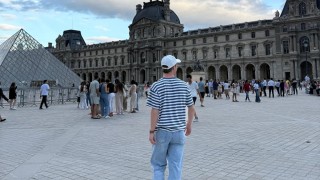
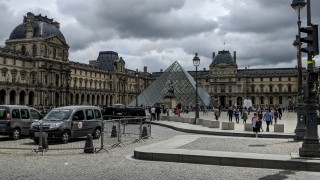
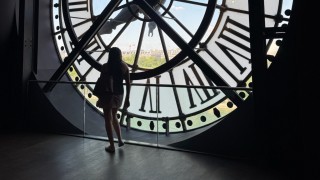
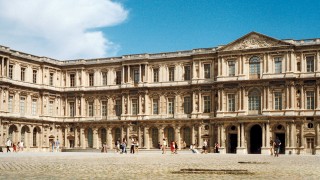
Combining these two Core courses into a single experience offers the opportunity for a rich exchange between the multiple contexts of Western artistic and musical creation. Open to Columbia undergraduate students, this is a special opportunity to take the courses in Columbia’s Core that pertain to the arts while studying abroad in a city particularly suited to artistic investigation.
This summer was a dream! One of the best parts of my Columbia experiences so far. It brings one's appreciation of art and music to a completely different level by not just teaching you the skills to interpret works but also the love for them. — Past Participant
Please note that the Columbia Summer Core in Berlin: Art Humanities and Music Humanities will not run during the Summer 2026 semester. Please note the Columbia Summer in Paris: English Track offers standalone Art Humanities and Music Humanities courses. Please speak with the UGE Adviser below for more information.
Program Overview
- Take both Art Humanities and Music Humanities in 6 weeks
- Distinct disciplinary focus with overlapping emphasis on Parisian musical and visual cultures
- Shared concerts, museum visits, and trips to important sites in the region
- Live and study with other Columbia undergraduates in a Parisian student residence
- 3 points of credit for each course appearing on Columbia transcript
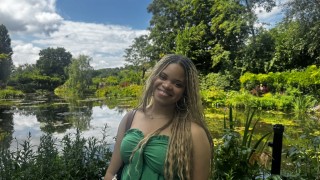
The museum visits and trips to Amiens, Giverny, Amsterdam, the opera and others enhanced my learning experience and engagement with the material. Not only could we apply classroom knowledge to the real pieces of art and music, but the lectures given on sight were incredible. In no other setting could I have learned so much in such depth. — Past Participant
We encourage you to watch the Columbia Summer Core in Paris | Info Session to learn more about the structure of the program and the application components:
Eligibility and Application
Eligibility
- Must be a currently enrolled student in Columbia College, Columbia Engineering, or the School of General Studies
- May not have taken Art Humanities or Music Humanities
- All students must meet the basic requirements for studying abroad: a 3.0 cumulative GPA, a 3.0 GPA during the semester before going abroad, and good academic and disciplinary standing in their home school
- Although knowledge of French is not required, some study of the language will be useful for students living in Paris
How to Apply
Want to apply? Click the “Start Your Application” button above. If the button doesn't appear above, the program is not yet accepting applications. You will be asked to set up a short profile, which will allow us to send you relevant information about your application. Once you’ve created a profile, you will see a checklist of items that you will need to submit. These generally include:
- Application Items
- Official Transcript(s)
- Statement of Interest | Students will be asked to write 400-500 words on the following topics:
- Why do you want to take these two courses together in the city you've chosen?
- What personal skills and/or experiences do you think will contribute to your success in an intensive program away from the Morningside campus?
- What aspects of your Core experience would you like to see continued and/or challenged in studying Art Humanities and Music Humanities abroad?
NOTE: This program includes an interview process for admission. Selected applicants are invited to interview with the faculty members.
Academics
Summer Core Courses
HUMA1121OC: Art Humanities, 3 credits
Art Humanities teaches students how to look at, think about, and engage in critical discussion of the visual arts. The course focuses on the formal structure of works of architecture, painting, and other media, as well as the historical context in which these works were made and understood. In addition to discussion-based classes like those held in New York, Art Humanities in Paris will make extensive use of the city through field trips to museums, buildings, and monuments.
HUMA1123OC: Music Humanities, 3 credits
The focus of Music Humanities is the masterpieces of Western art music in their historical and cultural contexts. The specific goals of the course are to awaken and encourage an appreciation of Western music, to help the student learn to respond intelligently to a variety of musical idioms and to engage the student in the issues of various debates about the character and purposes of music that have occupied composers and musical thinkers since ancient times. Students become actively involved in the process of critical listening both in the classroom and in the live performances that are as central to the course in Paris as in New York. Using a “great works” approach, the course will look at the changing genres and styles of music, examining composers’ choices and assumptions, as well as those of their patrons and audiences, as it moves chronologically from the Middle Ages to the present.
Note: The University reserves the right to withdraw or modify the courses of instruction or to change the instructors as may become necessary. Also, attendance at all class meetings, concerts, and excursions, unless otherwise indicated, is mandatory.
I would definitely recommend this program to other students due to the strong sense of community that was established between the students, professors, and program assistants. Just being together in another country and having an extremely packed and intense schedule made us a lot closer. In addition, I think the professors did a very good job of integrating the established course material with the city of Paris itself. — Past Participant
PROGRAM DATES
The program will be intensive, and students should expect to devote much of their time to their classes, coursework, and attending the specially planned co-curricular and extra-curricular activities. A more detailed schedule will be provided at a later date.
Classes are typically held Monday through Thursday, while on most Fridays and weekends, activities are planned in conjunction with the courses to provide more cultural exposure to the city.
All students are required to attend the orientation, which will provide an introduction to life in Paris and other important information. Program housing is not available outside of the program dates.
GRADING POLICY
Click here for the Columbia summer program grading policies.
TRANSCRIPTS
Upon successful completion of the program, grades are entered into SSOL as Columbia grades and are calculated as part of your GPA.
Credit is not granted to students who do not complete the full program
Life in Paris
Housing
All students will be housed together in double rooms at a residence in Paris. It is required that you live in the program housing. Program housing is not available outside of the program dates.
The quality of the dormitory wasn't what I was used to back on New York campus in the Columbia dorms, but the friendly staff, quiet floors, and INCREDIBLE location completely make up for everything else. The Luxembourg subway stop right outside the door was invaluable. The Foyer really became a home towards the end, and I will miss it a lot. — Past Participant
Meals
No meals are included, and there is no meal plan. However, there are grocery stores, boulangeries, fromageries, and charcuteries where students can buy food for casual dining.
There are several low-budget travel guides that give information about where to eat in Paris, as well as many blogs devoted to eating in Paris. We recommend taking the time to do some research beforehand if you are unsure about what to expect.
Program Activities
The program has many course-related activities, as well as a few social events, that will help students engage with the cultural life of Paris. Past social and cultural activities have included theater workshops, pottery, crépe-making, wine tasting, and excursions around Paris. You will have adequate time to explore Paris on your own and to soak up the ambiance of the city Paris in the summer.
In addition, the Columbia Global Center | Paris has many activities throughout the summer that are open to students on the program at no charge.
Daily Living and Schedule
This program has a very full schedule and students should expect to devote most of their time in Paris to the program and complementary activities. Classes meet Monday through Thursday; most Fridays and weekends are reserved for excursions. Students will spend a lot of time with each other and the instructors of the course.
Location
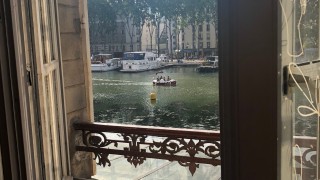
Columbia Global Centers | Paris, located at Reid Hall, is the home base of the program and where you will take all of your classes. Reid Hall is a small group of buildings owned and administered by Columbia. It also serves as an educational center for other American universities and for scholars from around the world. For over a century, its long and distinguished past of intellectual, artistic, and cultural exchange has made it significant to the relationship between France and the United States.
Located in the lively Montparnasse (sixth) district of Paris, near the Luxembourg Gardens and within walking distance of the Latin Quarter and several branches of the University of Paris, Reid Hall was constructed in the early 18th century, before the French Revolution. Modern additions have enlarged the facility, creating an interior courtyard and private garden. Reid Hall primarily houses administrative offices and classrooms and also has a small reference library, a reading room, lounges, a multimedia lab, and two large conference rooms. Students have access to WiFi in all common areas of Reid Hall.
Frequently Asked Questions
Q: How competitive is this program?
A: This program is very competitive. You are encouraged to have a backup study abroad program in mind if applying.
Q: I noticed that the Columbia Summer Core in Berlin: Art Humanities and Music Humanities program is on hiatus this Summer 2026 semester. How will that impact my application?
A: We encourage you to consider the Columbia Summer in Paris: English Track, which offers standalone Art Humanities and Music Humanities courses. You will not be able to take these courses simultaneously on the English Track, but you can supplement your experience by completing a Global Core requirement. Additionally, Global Core courses are offered on the Columbia Summer in Venice, the Columbia Summer Global Core in Athens: Ancient and Modern Olympics, and the Columbia Summer Global Core in Athens: Athens Curatorial Project programs.
Q: Can first-year students apply? Will upperclassmen get priority?
A: All students are welcome to apply. No preference is given to upperclassmen or students with a certain major.
Q: If I was rejected last year, can I apply again?
A: If interested, students are encouraged to apply again; any previous applications are not taken into account.
Q: I am interested in the program, but would need financial assistance in order to attend.
A: Please carefully read the Financial Considerations page, which includes a list of different websites to search for external scholarships. While UGE does offer a limited number of Global Learning Scholarships (GLS; see more information below), these are typically small grants that cover only a small portion of your program tuition. If you would like to apply for additional summer scholarships, you should start researching and applying as early as possible.
People
Staff
The faculty and program are supported by the staff of the Columbia Undergraduate Programs in Paris and the Columbia Global Centers: Paris. While you may encounter any number of staff members onsite, you will mostly interact with the Columbia Undergraduate Programs director, Séverine Martin-Hartenstein and the Administrative Assistant, Lucille Lancry.
Faculty
Walter Frisch is H. Harold Gumm/Harry and Albert von Tilzer Professor of Music at Columbia University in New York, where he has taught since 1982. He has also been a guest professor at the University of Freiburg in Germany, Yale University, Princeton University, and the University of Pennsylvania. He has lectured on music throughout the United States, and in England, France, Spain, Germany, and China. His writings have been translated into French, German, Spanish, Italian, Japanese, and Chinese.
Professor Frisch is a specialist in the music of composers from the Austro-German sphere in the nineteenth and twentieth centuries, ranging from Schubert to Schoenberg. He has written numerous articles and two books on Brahms, including Brahms and the Principle of Developing Variation (1984) and Brahms: the Four Symphonies (1996, 2003). He served as editor of the volume Brahms and His World (1990, 2009) and was the founding president of the American Brahms Society in 1983. He is the co-author, with George S. Bozarth, of the Brahms article in the second edition of the New Grove Dictionary of Music and Musicians (2000).
Mariusz Kozak is Associate Professor of Music at Columbia University. His first book, Enacting Musical Time: The Bodily Experience of New Music (Oxford University Press), which won the 2023 Society for Music Theory Emerging Scholar Award, examines how listeners' understanding and experience of musical time are shaped by bodily actions and gestures. His research centers on the relationship between music, cognition, and the body. Kozak bridges experimental approaches from embodied cognition with phenomenology and music analysis, in particular using motion-capture technology to study the movements of performers and listeners. His articles have appeared in the Journal of Music Theory, Music Theory Spectrum, and Music Theory Online, among others. In 2020 he was one of the keynote speakers at the Annual Meeting of the Society for Music Theory. His article "Feeling Meter: Kinesthetic Knowledge and the Case of Progressive Metal" (Journal of Music Theory) won the SMT Outstanding Publication Award in 2023. He is currently writing two books: one on the cultural and intellectual history of the cognitive science of music, and another on creativity and artificial intelligence.
Ioannis Mylonopoulos was educated at the University of Athens and the Ruprecht-Karls Universität Heidelberg (Ph.D. summa cum laude 2001). Before coming to Columbia in 2008, Mylonopoulos was a Research Associate at the University of Heidelberg (2001-03), Assistant Professor at the University of Vienna (2003-06), and Junior Professor at the University of Erfurt (2006-08).
In 2007/08, Mylonopoulos was a Fellow of the Harvard Center for Hellenic Studies. In 2011/12, he was a member of the School of Historical Studies of the Institute for Advanced Study, Princeton. In the spring of 2015, he was a visiting professor at Paris I Panthéon-Sorbonne and the first Columbia professor to teach Art Humanities in Paris. Mylonopoulos has received fellowships and grants from the Alexander S. Onassis Foundation, the German Archaeological Society, the Ernst-Kirsten Society, the Friedrich-Naumann Foundation, the Gerda-Henkel Foundation, and the German Research Council.
Irina Oryshkevich received her Ph.D. in Art History from Columbia University in 2003. Since completing her dissertation--a study of the history of the Roman catacombs from late antiquity to the early modern period--she has been a fellow at the Society of Fellows at Columbia University and a recipient of a grant from the American Association of University Women (AAUW).
Since her dissertation, Dr. Oryshkevich has focused on the cult of martyrs and the historiography of the early Church in the Counter Reformation, and their impact on the nascent discipline of 'Christian archaeology'. She will devote her residency at the Italian Academy to what is in effect a sequel to her dissertation, namely, the transformation of the catacombs, which had been viewed throughout the middle ages as mere cemeteries, into 'Roma sotterranea', a clandestine city that sheltered thousands of Christians from imperial persecutions. This transformation, assisted through imagery and rhetoric, provided Christian Rome with physical foundations, thereby reconfirming its primacy at a time when the papacy was under fierce attack on every confessional front.
Financial Considerations
Summer 2026 Tuition & Fees*
Please see our cost breakdown for detailed information.
*Tuition and fees are subject to the Board of Trustees' approval and may change.
Financial Aid and Scholarships
If you receive financial aid during the academic year, you may remain eligible for financial aid when you attend a summer Columbia-Led Program as long as you take a minimum of 6 points.
CC/SEAS: Contact the CC/SEAS Financial Aid & Educational Planning to understand if any of your federal financial aid may cover enrollment costs for a summer program. Please note the Columbia Grant is not available for summer studies.
General Studies: Contact the GS Office of Educational Financing to understand if any of your financial aid may cover participation in a summer program.
GLOBAL LEARNING SCHOLARSHIP
The Center for Undergraduate Global Engagement (UGE) offers the Global Learning Scholarship (GLS) to support Columbia students so they may enhance their undergraduate education by participating in a summer global learning opportunity.
Eligibility:
You are eligible for the Global Learning Scholarships (GLS) if you are:
A Columbia College, Columbia Engineering, or General Studies student who demonstrates financial need
All other students are not eligible for the GLS
Application and Timeline:
Students apply for the Global Learning Scholarship (GLS) and the Columbia-Led summer program with two separate applications.
Scholarship applications are due: Friday, February 13th, 2026 (closes at 11:59 PM EST)
GLS applicants must also submit a completed program application by the program application deadline OR no later than the following: Friday, February 13th, 2026 (closes at 11:59 PM EST)
To apply to the Global Learning Scholarship, please click here.
OTHER SCHOLARSHIPS
For a list of other scholarships specific to study abroad, please visit our Financial Considerations page > Fellowships and Scholarships for Studying Abroad section for more information. Of note are the:
Withdrawal Policy
To learn about the financial consequences of withdrawing from the program, please review the Summer Withdrawal and Refund Policy here.
Find Out More
After being accepted to the program, we will share information and email communications regarding the next steps. We understand that there will be a lot of steps to complete, so please utilize the resources below to help you get started:
Speak to an Adviser: Want to learn more? Make an appointment to chat with the adviser for this program! You can also email them with any questions, or to arrange a meeting if you are unable to make the listed times.
Applying: Make sure to review the dates and deadlines section at the bottom of the page.
Resources: View our Steps to Study Abroad page to see advice on Where to Begin, how to Prepare to Go, and what you need to know when Returning from Abroad. We will share many resources with you throughout the application and pre-departure process for preparing to study abroad.
We recommend reviewing the following before you apply:
Having a valid passport is one of the key components of going abroad. See more on our Passports and Visas page.
Need help deciding which semester, program, and experience are right for you? Check out our Choosing a Study Abroad Program page.
Learn about finances and study abroad on our Financial Considerations page.
If considering summer study abroad, review guidance on our Summer Study Abroad page.
Plan ahead and prepare for your health, well-being, and accessibility abroad by reviewing our Well-Being Abroad resources and Identity and Diversity Abroad page.
Once accepted, make sure to review the Prepare to Go page for more resources and information about preparing for your experience abroad.